


Looking at the Kennedy Center from Lincoln Center
The Kennedy Center has become a political football over the last year. President Trump fired the board and installed loyalists who permitted him to add his name to the building and approved his bid to close the center for two years for renovation. Administrators have fled; even Trump’s handpicked leader has left after just a year at the helm. Artists have canceled bookings, ticket sales have dropped precipitously. Then a judge overturned the renaming and it appears the name has returned to the original—but it remains shrouded from the public by a tarp and the need for renovation questioned. Now the Trump administration is even dangling the threat of demolition.
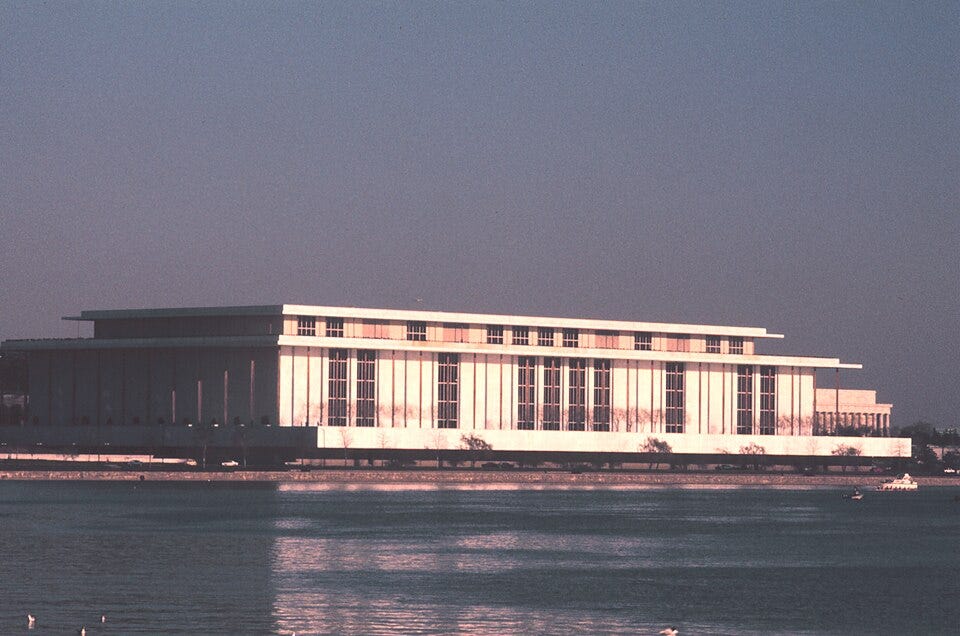
That threat is a betrayal of honor to an assassinated president, an affront to a grandly designed city, and an abasement of the arts. Even the stated two-year closing for renovations is less about a deteriorating building and more about making up a rationale to add Trump’s name to the building.
The Kennedy Center, though, needs a rejuvenation—just not of the building kind. Like Lincoln Center in New York, the Kennedy Center arose to prove the nation’s dominance in the cultural realm in addition to the military one in the aftermath of World War 2. These buildings were arts institutions cloaked as grand monuments. They aspired to put New York and Washington, D.C.—and the United States—on par with cities in Europe or ancient civilizations in Tokyo or Athens.
That grandiosity, though, works against the commitment to bring the arts to more people. Recent efforts of Lincoln Center suggest another approach—to renovate and reorient the complex to the people near it.
During initial discussions about the Kennedy Center and Lincoln Center in the 1950s, a familiar fear surfaced: government funding for the arts should not impose ideology in a functioning democracy. In fact, the flourishing of the arts demanded the opposite—the full-flowered freedom to pursue individual curiosity and imagination.
Establishing performing arts centers managed the tension. The charge was to construct and maintain the buildings with public dollars and leave programming and support of artists to philanthropic donations.
Both centers were implantations in their cities. The Kennedy Center was built on the site of an industrial brewery by the Potomac but did not require the demolition and dislocation of an entire neighborhood. The construction for Lincoln Center razed the racially-mixed, working-class neighborhood of San Juan Hill, forcing its residents to move across the city.
That dislocation was congruent with urban renewal projects at the time, following builder Robert Moses’s maxim that you need to break some eggs to make an omelet. But those who were forced to move were also those least likely to benefit from their sacrifice. The expressive activities in nightclubs, local theaters, and neighborhood centers in San Juan Hill were demolished along with the tenement buildings.
The new marble buildings and plaza blazoned exclusivity not invitation.
That history of discrimination—of its founding as well as its programming—has prompted a reckoning at Lincoln Center over the last few years. The umbrella organization has subsidized a documentary film about San Juan Hill, created a website with commissioned essays about that past (including mine on The Ground Beneath West Side Story), and offers programming tied to the legacy of the residents and their cultural activities in San Juan Hill, from jazz to salsa. (I have written an essay about the current Legacies of San Juan Hill Festival, with performances until October 30, in Vital City.)
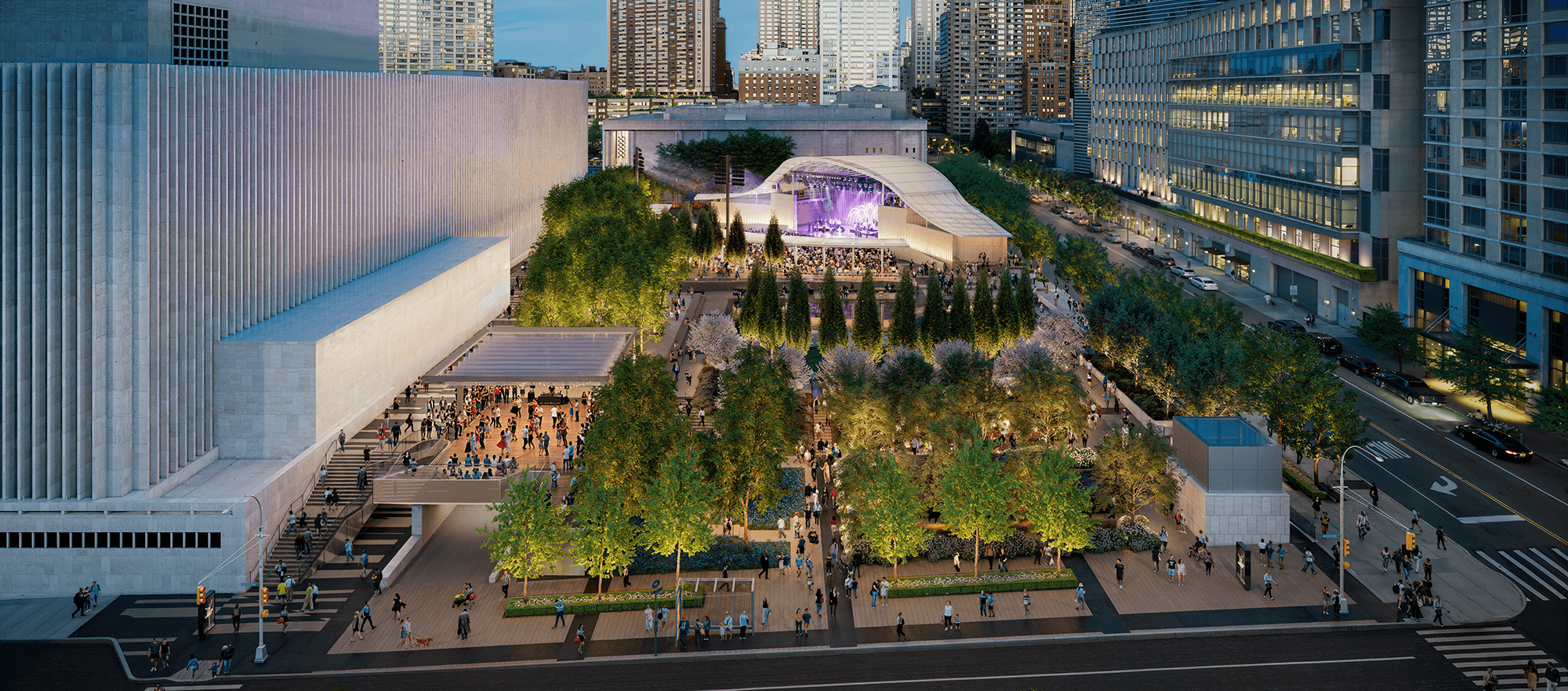
Most significantly, Lincoln Center is undertaking a renovation of the southwest corner of the campus where an outdoor amphitheater put its back to a public housing complex across the street. The amphitheater extended the high marble wall of the back of the Metropolitan Opera House—long viewed as a material and cultural sign of ignoring Lincoln Center’s west side neighbors.
Changing this orientation of the complex was the most obvious way to demonstrate the institution’s commitment to wider access. Lincoln Center held multiple community planning sessions, actively seeking the opinions of their neighbors about what they needed and wanted from a nearby cultural institution. It is now embarked on the renovation, with a sloped set of stairs onto Amsterdam Avenue, more trees and sitting spots, and an up-to-date outdoor stage that faces the housing complex. The new design invites neighbors into the activities of the institution.
Lincoln Center and the Kennedy Center face the same challenges of building maintenance, rising costs of arts productions, and audiences accustomed to entertainment by finger swipes. But unlike President Trump and his cronies overseeing the Kennedy Center, the leaders at Lincoln Center have realized that buildings are only as good as what is around and inside them.
Proposing demolition or even significant renovation mistakes the building for what’s inside it, polishing a platform instead of nurturing artists and audiences for vital expressions of insight and humanity. We need less gold and glitter, pomp and circumstance, and more opportunities to exchange visions of the world, share pleasure and despair, through acts of imagination and creativity.
When we value the edifice over the performance, we have mistaken the symbol for the meaning. A re-making of a building may be the most superficial performance of all.
"When we value the edifice over the performance, we have mistaken the symbol for the meaning." Thanks for this enlightening post, Julia!
The contrast between Lincoln Center turning its amphitheater toward the public housing across the street and the Kennedy Center fight over its name makes the point well: a building's meaning comes from who it faces, not how grand it looks. I also found it telling that the community planning sessions came before the renovation, with neighbors asked what they wanted. Do you think that kind of consultation can undo a founding exclusion like San Juan Hill, or only soften how it is felt today?